Wall Art Tips — Mindful Interiors
How to Choose Wall Art for a Japandi Interior
September 6, 2026
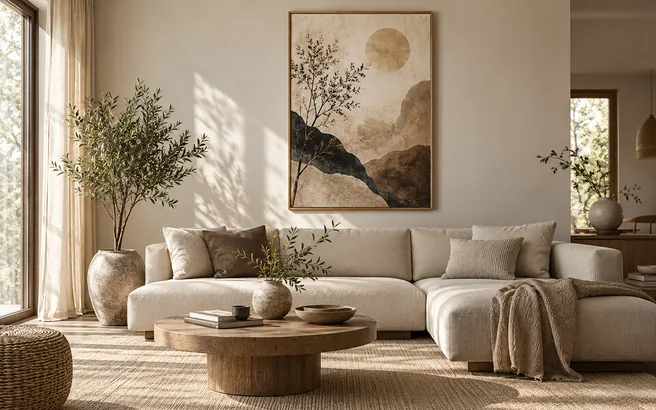
Japandi interiors are known for their calm atmosphere, natural materials and thoughtful simplicity. But creating a minimalist space does not mean leaving every wall empty. The right Japandi wall art can bring warmth, character and depth to a room while preserving the sense of balance that makes these interiors so inviting.
The key is not simply to search for something that looks Japandi. Instead, consider what your room already contains and what the artwork needs to contribute.
Does the space need warmth? Contrast? A stronger focal point? Or simply one quiet element that brings everything together?
This guide will help you choose wall art that feels naturally connected to a Japandi interior rather than added as an afterthought.
What Makes Wall Art Work in a Japandi Interior?
Japandi combines the simplicity and appreciation of nature associated with Japanese interiors with the warmth and comfort found in Scandinavian design.
Natural materials, organic forms, uncluttered spaces and restrained color palettes all play an important role. The same principles can guide your choice of wall art.
Artwork that works particularly well in a Japandi-inspired room often features:
- organic or simplified forms;
- landscapes and botanical subjects;
- restrained abstract compositions;
- earthy or muted colors;
- intentional negative space;
- simple lines and balanced proportions.
The goal is not to make the artwork disappear into the room. A successful piece should still have presence. It simply should not compete with everything around it.
Start With the Room, Not the Artwork
It is tempting to choose a print first and work out where to put it later.
Try reversing that process.
Before selecting wall art, look carefully at the room itself.
Consider the color of the walls, the tone of the wood, the fabrics, the amount of natural light and the furniture surrounding the empty wall.
Then ask a simple question:
What does this room need?
A very pale room might benefit from a darker visual anchor.
A room filled with dark wood may need artwork with more open, lighter areas.
A space containing several decorative objects may benefit from one simple piece rather than another collection of smaller elements.
This approach helps the artwork become part of the interior rather than something placed on top of it.
Choose a Natural, Restrained Color Palette
Neutral does not have to mean beige on beige.
Japandi interiors can combine warm whites, sand and stone with deeper earthy shades such as brown, muted green, charcoal and black. Natural materials and contrasting light and dark tones are both common characteristics of the style.
Use the existing room as your starting point.
If your room is very light and neutral
Consider artwork containing a controlled darker element such as charcoal, deep brown or muted green. A little contrast can prevent a pale interior from feeling flat.
If your furniture uses dark wood
A lighter composition can provide visual breathing room and keep the wall from becoming too heavy.
If the room feels cold
Warm beige, sand, soft brown or muted terracotta can introduce warmth without overwhelming the space.
If the room already contains several colors
Choose artwork with a quieter palette and simpler composition.
You do not need to match every color perfectly. In fact, an interior often feels more natural when colors relate to one another without being identical.
Let Nature Influence the Artwork
Nature sits comfortably within the Japandi aesthetic.
Both Japanese and Scandinavian interiors have strong relationships with natural materials and the outdoors, making nature-inspired artwork an especially natural fit.
Consider subjects such as:
- trees and branches;
- botanical forms;
- mountains;
- coastlines and water;
- natural landscapes;
- organic abstract shapes.
The connection does not have to be literal.
An abstract composition inspired by a horizon, stone, flowing water or botanical shapes can introduce the same feeling without depicting a recognizable landscape.
Explore nature-inspired wall art
Discover Stillume’s Zen & Balance and Minimal Landscapes collections for artwork built around quiet landscapes, organic forms and nature-inspired compositions.
Use Contrast Without Creating Visual Noise
One of the easiest mistakes when decorating a Japandi-inspired room is making everything equally pale.
A calm interior still needs hierarchy.
A dark line, charcoal form, deep brown shape or muted earthy accent can give the eye somewhere to rest.
The important distinction is between contrast and clutter.
Contrast creates a focal point.
Clutter creates several elements competing for attention.
If your room already contains expressive wood grain, textured fabrics, ceramics and plants, the artwork may need to be quieter.
If the room is extremely simple, the artwork can carry slightly more visual weight.
The aim is balance, not uniformity.
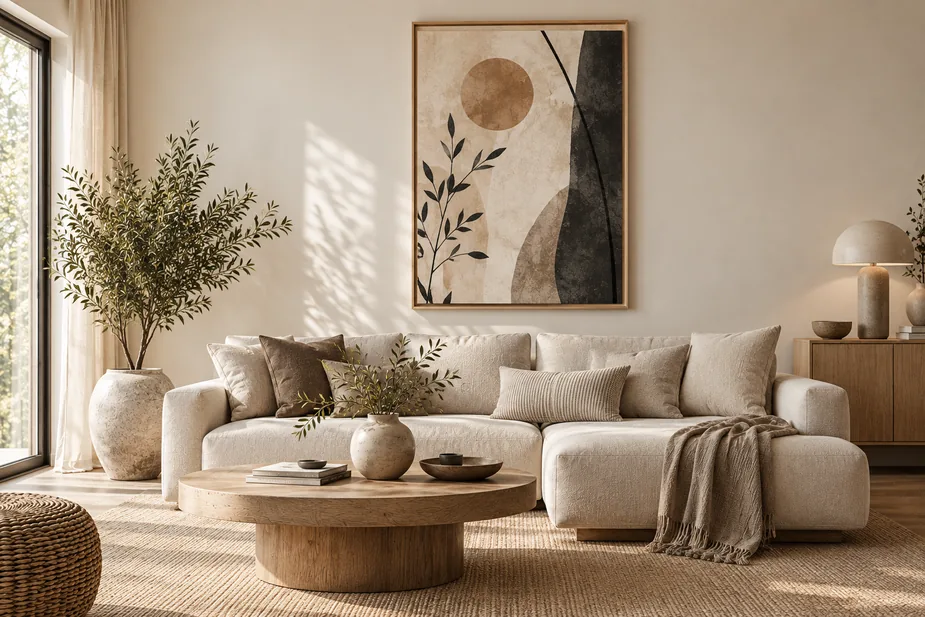
One Large Print or a Small Coordinated Set?
Both can work.
A single large artwork often suits Japandi interiors particularly well because it creates a clear focal point while keeping the surrounding wall visually quiet.
But minimalism does not mean that multiple artworks are forbidden by some international Japandi tribunal.
Two or three coordinated prints can work beautifully when their palette, proportions and spacing create a sense of order.
Think about the architecture of the wall.
Above a wide sofa or sideboard
A larger horizontal visual area can support one substantial artwork or a carefully spaced group.
On a narrow wall
A vertical print can emphasize height without filling the entire surface.
Along a long empty wall
A small coordinated series can introduce rhythm while maintaining consistency.
In a room that already feels busy
Choose one strong piece and give it space.
If you are combining several artworks, our How to Mix Wall Art for a Stunning, Balanced Look guide explores composition and visual balance in more detail.
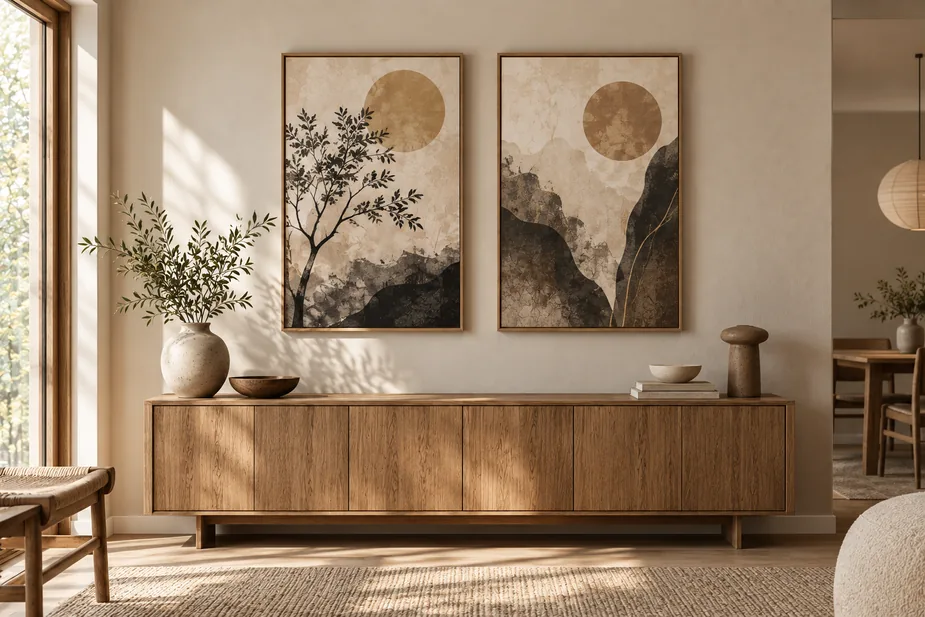
Match Wall Art With Materials and Furniture
Wall art does not exist separately from furniture.
In a Japandi room, it shares the space with materials such as wood, linen, wool, stone and ceramic.
Instead of trying to match the exact color of your artwork to your sofa or table, look for relationships.
- Warm wood can connect beautifully with sand, ochre or earthy brown.
- Light oak can sit comfortably beside soft black line art or muted botanical tones.
- Stone and linen can be complemented by organic shapes and subtle texture.
- Dark furniture can be balanced by artwork containing lighter negative space.
The objective is not perfect coordination. It is visual conversation.
Choose a Frame That Supports the Artwork
The frame should help the artwork belong in the room without becoming the loudest object on the wall.
Natural wood is an obvious choice for many Japandi interiors because it connects easily with other wooden elements in the room.
Light woods can reinforce an airy Scandinavian influence, while warmer or darker woods can add depth.
A slim dark frame can also work particularly well when the room needs definition or when the artwork contains darker details.
Avoid assuming that every Japandi print requires exactly the same frame.
Look at the artwork, furniture and surrounding materials together.
The simplest choice is usually the one that lets the artwork remain the focal point.
Give the Artwork Room to Breathe
Empty space is not wasted space.
In a restrained interior, the wall surrounding an artwork becomes part of the composition.
Avoid choosing a print simply because it fills every available centimeter. Leaving sufficient space around an artwork allows its shape and proportions to register more clearly and helps maintain the calm visual rhythm associated with minimalist interiors.
At the same time, do not confuse negative space with undersized art.
A tiny print floating above a large sofa can look accidental rather than minimal.
Scale still matters.
For practical guidance on choosing proportions for different walls and rooms, see our Printable Wall Art Size Guide.
Japandi Wall Art Ideas for Different Rooms
The same design principles can produce different results depending on the room.
Living Room
The living room usually offers the strongest opportunity for a focal point.
Above a sofa, console or low cabinet, consider artwork substantial enough to hold its own against the furniture below it.
Nature-inspired landscapes, organic abstraction and restrained botanical artwork can all work well.
If the furniture and textiles are very neutral, this is also a good place to introduce controlled contrast.
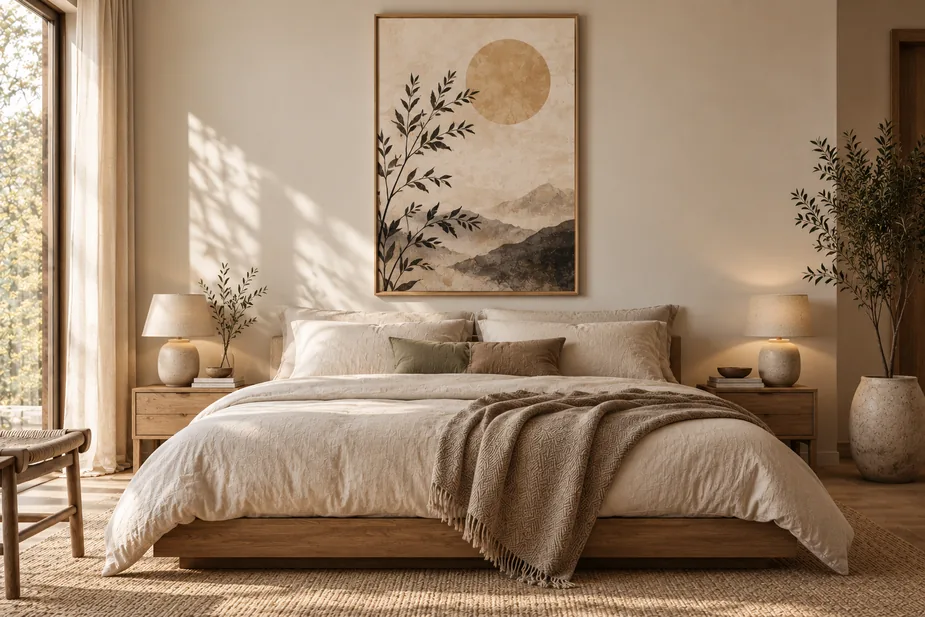
Bedroom
A bedroom benefits from artwork that supports a restful atmosphere rather than demanding attention.
Consider softer compositions, botanical forms, quiet landscapes or abstract artwork with plenty of visual breathing room.
A single piece can create a particularly calm focal point above a bed or dresser.
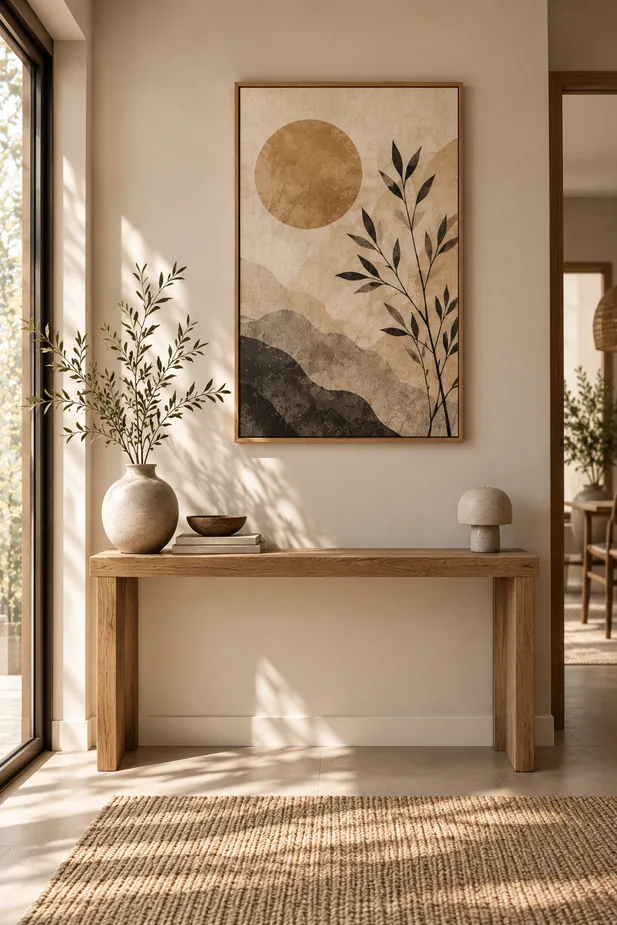
Entryway
An entryway offers a chance to establish the mood of the home immediately.
A vertical artwork above a simple console can work particularly well in a narrow space.
Keep surrounding objects intentional. A ceramic vessel, small lamp or branch may be enough.
The artwork does not need an entourage.
Home Office
A home office should feel focused without becoming sterile.
Wall art can introduce warmth and personality while maintaining visual order.
Consider an organic abstract composition, minimal landscape or botanical subject that provides interest without becoming distracting.
Common Mistakes to Avoid
Japandi is simple, but simplicity is surprisingly easy to overcomplicate.
Choosing artwork that is too small
Minimalism does not require miniature artwork.
Choose a scale appropriate to the wall and the furniture around it.
Making everything beige
A completely uniform palette can remove depth from the room.
Use subtle contrast to give the composition structure.
Adding too many small decorative pieces
If the room already contains several objects, adding many small artworks can fragment the wall further.
Sometimes one larger piece is the quieter choice.
Matching every color perfectly
Your artwork does not need to reproduce the exact shades of your rug, sofa and cushions.
Related tones usually create a more natural result than perfect matching.
Choosing imagery simply because it looks “Japanese”
Japandi is not created by adding stereotypically Japanese symbols to an otherwise unrelated room.
Focus instead on the deeper principles of simplicity, craftsmanship, nature, proportion and restraint.
Ignoring the room itself
An artwork may be beautiful on its own and still be wrong for a particular wall.
Always judge the artwork within the context in which it will live.
A Simple Japandi Wall Art Checklist
Before making your final choice, ask yourself:
- 1. Does the artwork complement the room’s existing palette? It does not need to match it exactly, but the colors should feel connected.
- 2. Does it provide enough contrast to remain visible? A calm room still needs focal points.
- 3. Does the subject or composition feel natural in the space? Look for a relationship with the room’s materials, shapes or atmosphere.
- 4. Is the artwork large enough for the wall and nearby furniture? Minimal should feel intentional, not undersized.
- 5. Is there enough empty space around it? Give the artwork room to breathe.
- 6. Would removing another decorative object improve the result? Sometimes the best addition to a room is actually a subtraction.
Bringing the Japandi Look Together
Choosing Japandi wall art is less about following a rigid set of rules and more about creating relationships between art, space, material, color and light.
Start with the room.
Identify what it needs.
Then choose artwork that answers that need without competing with the qualities already present.
A calm room may need contrast. A dark room may need lightness. A large empty wall may need scale rather than quantity. And a beautifully textured interior may need nothing more than one simple piece placed with intention.
That is where Japandi works best: not when everything looks deliberately styled, but when each element feels as though it naturally belongs.
For artwork built around quiet compositions, natural influences and balanced forms, explore Stillume’s Zen & Balance Collection and Minimal Landscapes Collection.
Useful Resources
IKEA – Bring Japandi Style Inspiration Into Your Home
Architectural Digest – 5 Japandi Living Rooms to Steal Serene Inspiration From